
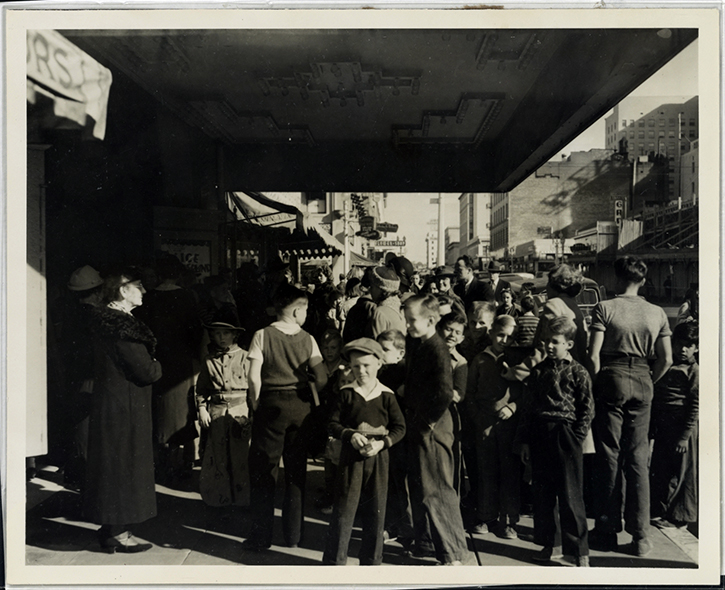
This week in class, we explored one of the popular pastimes of children in the early 1900s: going to the movies. You learned about nickelodeons, inexpensive movie theaters where admission often cost just five cents. These theaters became popular places for kids and families to gather and enjoy the latest films.
It’s hard to imagine what watching a movie must have felt like before television was available in people’s homes. Going to the movies would have been a much more magical experience when moving pictures were still a relatively new form of entertainment!
To bring this experience to life, you received a short segment of 8mm film to examine up close (movie theaters use 35mm film). You also got to see two film projectors, one from the 1930s and another from the 1970s. Although the projectors were newer than the equipment used in early nickelodeons, they gave us a chance to see how movies were shown before today’s digital technology. As an added bonus, you even got to watch me fumble with loading the projector as I demonstrated how to get a movie ready to play!
You experienced the light, smelled the hot dust, and heard the clickity-click of the projector as it brought the film to life. It was a very different experience from simply opening an app and choosing a movie!
On the wall, we projected a newsreel from the 1920s era, although the actual film was likely produced in the 1940s. We also previewed Two Tars, a silent comedy originally released in 1928, featuring Laurel and Hardy. Watching a film like this gives us a glimpse of the kind of entertainment audiences enjoyed nearly a century ago.
Before television became a regular part of everyday life, going to the movies was one way people could see what was happening in the world beyond their own communities. Along with the main feature film, movie theaters often showed short films called newsreels. Think of them as an early version of the television news.
Newsreels covered all sorts of things. You might see a story about an important world event, a new invention, a famous person, a sporting event, or even something unusual happening somewhere across the country. Instead of just reading about these things in a newspaper, audiences could actually see moving pictures of the people and places involved.
Newsreel companies sent cameramen out to film events. The footage was then edited into short news stories and sent to movie theaters. This took time, so by the time a newsreel reached your local theater, some of the events it covered might already have weeks earlier.
In the 1920s, most newsreels were silent, so viewers relied on written captions to explain what was happening. As sound technology improved, newsreels began including narration and sound. By the 1930s and 1940s, they had become a familiar part of going to the movies.
Newsreels are interesting to watch today because they give us a glimpse of the past. We can see how people dressed, what their cities looked like, and which events were considered important enough to share with the public. Of course, someone had to decide which stories to include and which pictures to show, so a newsreel didn’t necessarily tell the whole story. That’s something worth remembering whenever we watch or read the news, whether it’s from the 1940s or today.
The technology has certainly changed, but our curiosity about what’s happening in the world hasn’t.
If you’ve ever watched a comedy where one person’s bad idea turns into a whole lot of trouble for everyone, you’ve already seen the kind of humor that made Laurel and Hardy famous.
Stan Laurel and Oliver Hardy were one of the most popular comedy teams in movie history. Stan was the thin one, born in England in 1890, while Ollie, the larger one, was born in Georgia in 1892. Both had experience performing and making movies before they began working together regularly in 1927.
Part of what made them so funny was how different their characters were. Stan was a well-meaning fellow who often seemed to make a mess of things without realizing it. Ollie liked to think of himself as the sensible one, but he usually ended up suffering right alongside Stan. No matter how simple their plans seemed at first, things had a way of going wrong.
They became famous for their facial expressions, physical comedy, and ability to turn an ordinary situation into a ridiculous disaster. They started out making silent films and later moved into movies with sound. Their partnership lasted for decades.
About Two Tars (1928)
In Two Tars, Stan Laurel and Oliver Hardy play two sailors who are out enjoying their time off. They meet two young women and head out for a drive. Things seem to be going well until they get caught in a traffic jam.
What follows is a good example of how Laurel and Hardy could turn a small problem into a huge mess. An argument between motorists gets out of hand, and before long, cars and their owners are caught up in a ridiculous chain of pranks and destruction.
This kind of humor is called slapstick comedy. Instead of relying on clever dialogue or complicated jokes, slapstick uses physical actions, mishaps, and exaggerated reactions to make people laugh. Think of someone slipping on a banana peel or a simple disagreement turning into a chaotic mess. That is the sort of comedy audiences enjoyed in silent movies.
Since Two Tars was made before talking pictures became common, the actors had to tell the story mostly through their actions and expressions. Watch Stan and Ollie closely, and notice how much you can understand just by looking at their faces and watching how they move. Their timing was an important part of what made the comedy work.
As you watch the film, imagine sitting in a movie theater in 1928. There was no television at home, and you couldn’t pull up a video on your phone whenever you wanted. Going to the movies was a special outing, and a comedy like Two Tars gave audiences a chance to forget their troubles and have a good laugh.
Nearly a hundred years later, the film may look different from the movies we watch today, but the basic idea is still the same. A couple of characters get into trouble, things keep getting worse, and we laugh to see what happens next.
If you’d like to watch the movie at home, you can find it here:
The films, equipment, and technology have changed dramatically, but our enjoyment of watching stories unfold on a screen has remained remarkably similar over the last 100 years. Children a century ago enjoyed going to the movies just as kids do today. They simply had a different way of doing it!
A lot has changed, but a lot has stayed the same!