
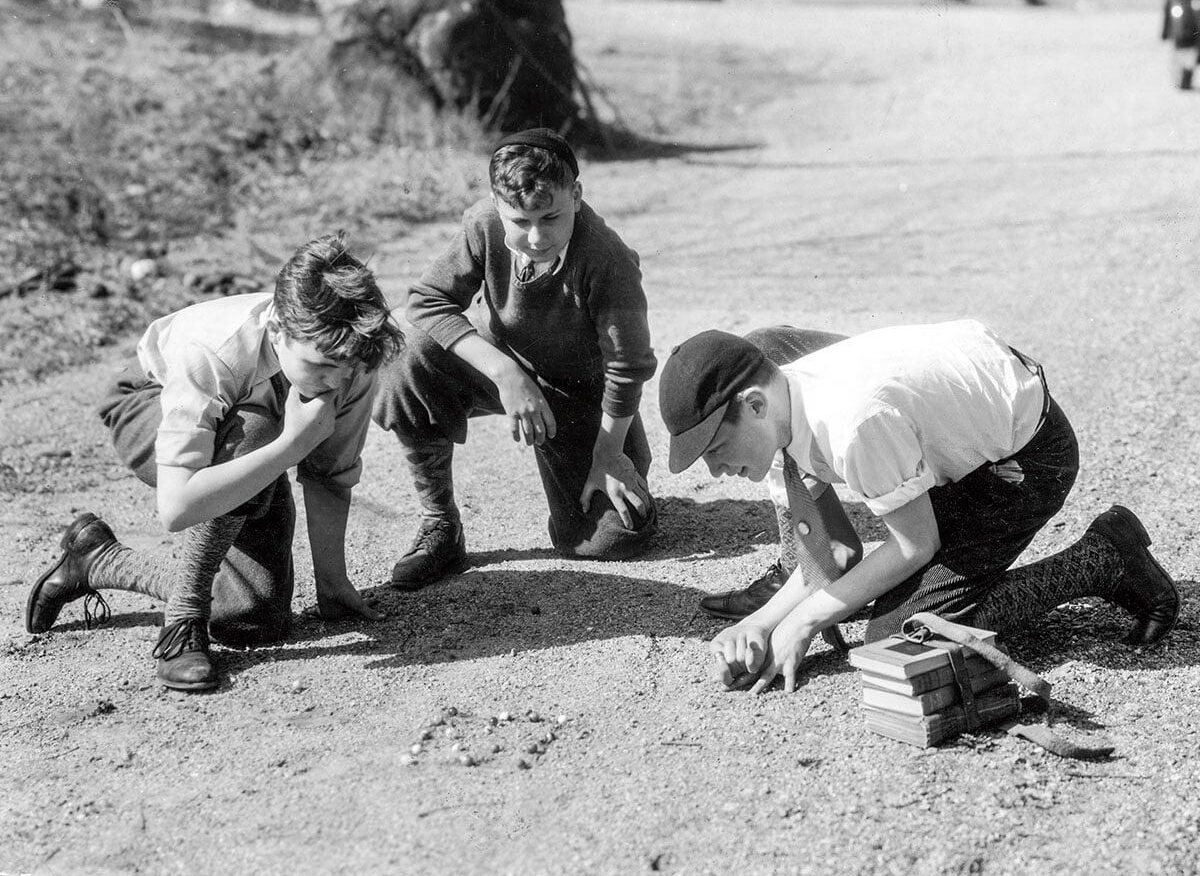
What better way to wrap up a course about the history of being a kid than by spending our last class playing a game that generations of children have enjoyed?
Marbles had come up in our conversations several times throughout the term, but we never quite found the time to play. Since it was such a popular childhood pastime throughout much of the first half of the 1900s, I thought it deserved a day of its own rather than being squeezed into a particular decade.
Marbles have a surprisingly long history. Small stones and balls have been used as gaming pieces for thousands of years. In ancient Egypt, for example, small stone balls are thought to have been used as playing pieces in the board game Mehen. These weren’t necessarily the same games children play with marbles today, but they show that people have enjoyed games involving small round objects for a very long time.
Our interest here, though, is in the game of marbles as children knew it in the early twentieth century, when a handful of marbles could provide hours of entertainment.

In class we learned some of the language of the game. The expression “knuckle down” has its roots in marbles. A dictionary published in 1740 records boys playing a game called taw saying, “Knuckle down to your taw,” as a player placed his hand on the ground exactly where his marble lay.
The expression also developed figurative meanings. The same 1740 dictionary records it as meaning to stoop, yield, or submit. The meaning we’re more familiar with today, applying oneself earnestly or vigorously to a task, is documented later, by 1864. So a phrase that began as an instruction in a children’s game eventually found its way into everyday language.
We also learned about shooters, the larger marbles used to knock other marbles out of the ring, and mibs, the smaller target marbles.
Once we understood the basics, it was time to play. We started with simple rules, but soon got into another interesting part of traditional games: local rules. The basic game might be the same, but children often had their own variations depending on where they lived and who they played with. There wasn’t necessarily one official way to play.

Over the past eight weeks, we’ve explored the toys, entertainment, and everyday experiences that shaped childhood in the first half of the 1900s. Along the way, we’ve seen how much has changed, but also how much has stayed the same. Kids still enjoy a little friendly competition, making up their own rules, and finding ways to have fun together. Sometimes all it takes is a handful of marbles.
How old is the game?
Marbles are much older than the 1900s! Children have played games with small stones, nuts, and little balls for thousands of years. Similar objects have even been found in ancient Egyptian and Roman archaeological sites.
Before glass, there was clay.
Some of the earliest manufactured marbles were made from clay. Glass marbles eventually became popular, and early glass examples were often handmade, one at a time.
Machines changed the game.
By the early 1900s, machines could produce glass marbles in large quantities. This made them much less expensive and helped turn marbles into an everyday childhood toy.
One of the people who helped mechanize marble production was Martin F. Christensen, an inventor based in Akron, Ohio. In 1902, Christensen filed a patent application for a machine that could roll softened material into spheres. His patent, granted in 1905, describes making glass balls ranging from small marbles to larger spheres.
Christensen’s company, M.F. Christensen & Son, was listed in the 1905 Akron city directory as a toy-marble manufacturer with a factory on East Exchange Street.
What’s a cat’s-eye?
You’ve probably seen these. Cat’s-eye marbles have colorful strands or ribbons suspended inside clear glass. They were introduced around 1951, according to the Maryland Archaeological Conservation Laboratory. That makes them a relatively late addition to the marble collection, appearing just as the postwar years (after WWII) began.
A marble by any other name…
Marble players had their own vocabulary. A shooter was the larger marble used to knock other marbles out of the ring. The smaller target marbles were called mibs. Collectors also have names for different patterns, including swirls, corkscrews, and cat’s-eyes.
The Blue Marble
In 1972, the crew of Apollo 17 took one of the most famous photographs of Earth from space. The photograph was taken on December 7, 1972, as the astronauts traveled toward the Moon. Known as “The Blue Marble,” it shows our planet looking much like a small blue marble suspended in the darkness of space.
You can see the original photograph and NASA’s historical caption in NASA’s image collection.
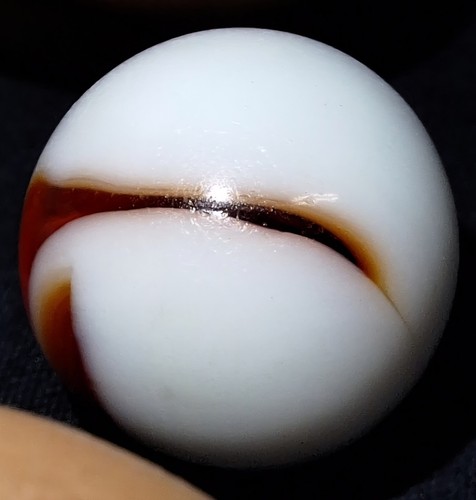
I love the connections all of you make during class! You are always helping me learn something new through your comments, questions, and observations, and today was no different. One of you made a great connection between our marble game and Mark Twain’s The Adventures of Tom Sawyer. It turns out there’s a little more marble history hiding in that classic story!
When Tom tries to persuade Jim to help whitewash Aunt Polly’s fence, he offers him a special marble: “I’ll give you a white alley!”
An alley (sometimes spelled ally) was a particularly fine or desirable marble. The name was thought to be connected to alabaster, a white stone from which some of these marbles were made. A nineteenth-century dictionary even records the term “ally taw” as referring to a genuine alabaster marble.
A taw was the special marble a player used to shoot at the others. It was often a larger or particularly prized marble. The term appears in written records as early as 1709.
Tom sweetens the deal by calling it a “bully taw.” In nineteenth-century slang, bully could mean fine, excellent, or first-rate. A slang dictionary published in 1874 notes that a good fellow or even a good horse might be called “bully.” So Tom wasn’t offering Jim just any old marble. He was offering something special!
We actually had a few marbles in class that looked much like the white alleys Tom was talking about.
Research
Sources & Further Reading
Ancient games and the history of marbles
- The Metropolitan Museum of Art, Board Games from Ancient Egypt and the Near East. Explores the ancient Egyptian game of Mehen and its playing pieces.
- The Metropolitan Museum of Art, Marble, Predynastic Period–Old Kingdom. An example of a small stone object that may have served as a game piece in ancient Egypt.
Marbles in American childhood
- Old Sturbridge Village, Early 19th-Century Games. Includes historical marble games, terminology, and instructions from early nineteenth-century New England.
- Smithsonian National Museum of American History, Humpty Dumpty Marble Game, 1896. An example of a commercially manufactured marble game from the nineteenth century.
- Library of Congress, Living on a Skyscraper, circa 1919. A historical photograph showing boys playing marbles.
- Library of Congress, Boys Playing Marbles, Woodbine, Iowa, 1940. A photograph documenting children’s play in the early twentieth century.
Marble manufacturing
- Museum of American Glass in West Virginia, The History of the Machine-Made Glass Marble. Covers Martin F. Christensen, Akro Agate, and the development of American marble manufacturing.
- U.S. Patent Office, Martin F. Christensen, Machine for Making Spherical Bodies or Balls, Patent 802,495, October 24, 1905.
- San Diego Archaeological Center, Historic Toy Marbles. Research on the materials, manufacturing, and designs of American toy marbles, particularly during the 1920s and 1930s.
- Maryland Archaeological Conservation Laboratory, Diagnostic Artifacts: Marbles. Identification and dating information for machine-made glass marbles, including cat’s-eye examples.
Marble terminology and language
- World English Historical Dictionary, Knuckle. Historical definitions and quotations documenting the expression’s connection to the game of marbles.
- World English Historical Dictionary, Taw. Historical definitions of the shooting marble.
- World English Historical Dictionary, Alley. Historical references to the superior marble known as an alley or ally.
- Dictionary.com, Mib. Definition and word origin.
- John Camden Hotten, The Slang Dictionary (1874), entry “Bully.” Documents the use of bully as a term of praise, including its application to a good fellow or horse.
Akron’s marble manufacturing history
- Akron City Directory, 1905, p. 983. Listing for M.F. Christensen & Son under toy-marble manufacturers.
- Akron City Directory, 1911, p. 378. Company listing and business information.
- Sanborn Map Company, Sanborn Fire Insurance Map from Akron, Summit County, Ohio, 1916, Vol. 1, Sheet 57.
Literature and popular culture
- Mark Twain, The Adventures of Tom Sawyer, Chapter II. Original text containing the reference to Tom’s white alley and bully taw.
Space exploration
- NASA, The Blue Marble. Original Apollo 17 photograph and accompanying historical record, December 7, 1972.